

Coffee is more than a daily habit. It is a drink shaped by centuries of travel, trade, culture, and innovation. From its mysterious beginnings in Africa to its role in modern cafés and global economies, coffee has evolved alongside human society. Understanding the history of coffee helps us appreciate how a simple bean became one of the most popular beverages in the world.
The Legendary Origins of Coffee
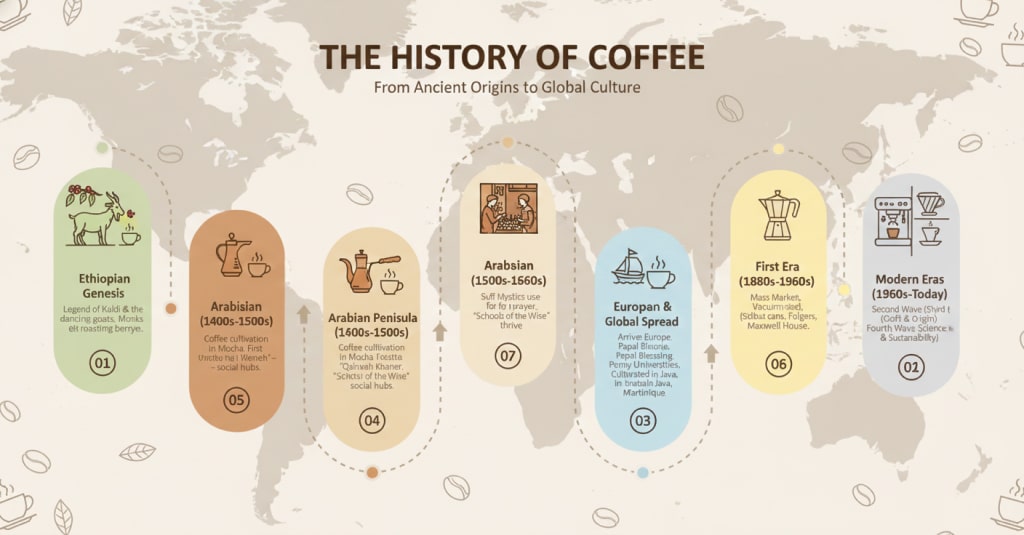
The story of coffee begins in Ethiopia, where coffee plants are believed to have grown wild thousands of years ago. According to legend, a goat herder named Kaldi noticed his goats becoming unusually energetic after eating red berries from a certain tree. Curious, he tried the berries himself and experienced a similar burst of energy.
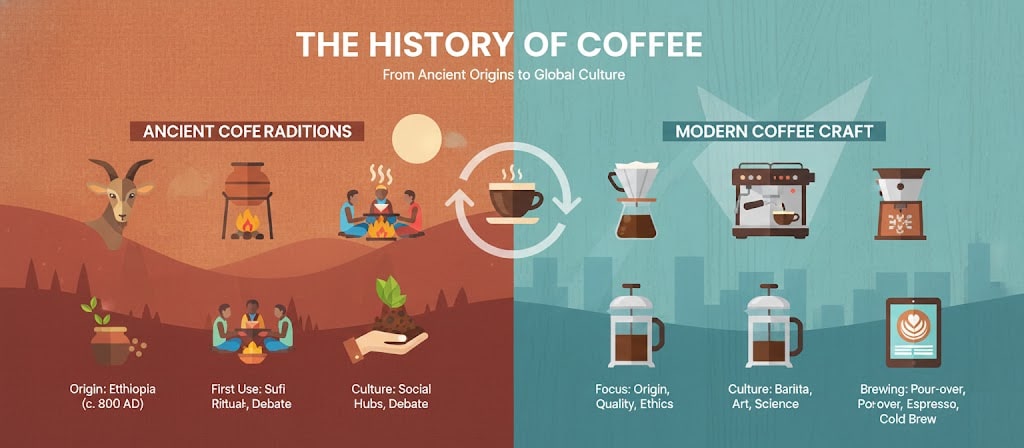
While the legend cannot be proven, it reflects an important truth: Ethiopia is widely recognized as the birthplace of coffee. Early communities likely chewed coffee cherries or mixed them with fat to create energy-rich food long before coffee was brewed as a drink.
Coffee’s Journey to the Arab World
Coffee made its first major journey beyond Africa to the Arabian Peninsula, particularly Yemen, around the 15th century. Here, coffee was cultivated and brewed in a form closer to what we recognize today. The drink quickly became popular among Sufi monks, who used it to stay alert during long hours of prayer and meditation.
Yemen became the center of early coffee trade, with the port city of Mocha playing a key role. The word “mocha” still echoes this history today. At this stage, coffee was tightly controlled, and exporting fertile beans was forbidden to maintain a monopoly.
The Rise of Coffeehouses
As coffee spread through the Middle East, coffeehouses began to appear in cities like Mecca, Cairo, and Istanbul. These spaces became known as places for conversation, music, games, and political discussion. Often called “schools of the wise,” coffeehouses played an important role in social life.
Not everyone welcomed coffee at first. Some religious leaders and rulers viewed coffeehouses as disruptive, leading to temporary bans. Despite resistance, coffee’s popularity continued to grow, fueled by its stimulating effects and social appeal.
Coffee Arrives in Europe
Coffee reached Europe in the 17th century through trade routes connecting the Ottoman Empire with Venice and other port cities. Initially met with suspicion, coffee was sometimes referred to as the “bitter invention of Satan.” However, attitudes changed after religious approval and growing curiosity.
European coffeehouses soon appeared in cities like London, Paris, and Vienna. These cafés became hubs for writers, merchants, scientists, and philosophers. In England, coffeehouses were even nicknamed “penny universities” because, for the price of a cup, one could engage in intellectual discussion and access news.
Global Expansion Through Colonization
As demand for coffee grew, European powers sought to cultivate it in their colonies. Coffee plants were smuggled out of the Arab world and introduced to regions with suitable climates. The Dutch successfully grew coffee in Java, while the French expanded production in the Caribbean.
Coffee eventually spread to Central and South America, with Brazil emerging as a dominant producer in the 19th century. Plantations expanded rapidly, often relying on enslaved or exploited labor, making coffee deeply connected to colonial history and global trade systems.
Industrialization and Mass Consumption
The Industrial Revolution transformed how coffee was produced, roasted, and consumed. Innovations in roasting technology and packaging made coffee more accessible to the growing urban population. Ground coffee and vacuum-sealed packaging extended shelf life and convenience.
In the 20th century, instant coffee emerged, appealing to consumers seeking speed and simplicity. Coffee became a staple in homes, offices, and military rations, firmly embedding itself into daily routines.
The Rise of Modern Coffee Culture
Late in the 20th century, a shift began toward higher-quality coffee and more intentional consumption. This movement, often called “specialty coffee,” emphasized bean origin, roasting methods, and brewing techniques. Cafés became places not just to drink coffee, but to experience it.
Today, coffee culture includes everything from artisanal roasters and barista competitions to sustainable sourcing and ethical trade practices. Consumers are more aware of where their coffee comes from and how it is produced.
Coffee in the Digital Age
In the modern era, coffee continues to evolve. Home brewing equipment has become more advanced and accessible, while online communities share knowledge about tasting, brewing, and roasting. Coffee is no longer just a beverage—it is a lifestyle and a global conversation.
Despite technological changes, the core appeal of coffee remains the same: connection, energy, and ritual. From ancient Ethiopian hillsides to today’s cafés and kitchens, coffee has traveled a remarkable path.
Conclusion
The history of coffee is a story of discovery, culture, and transformation. What began as a wild plant in Africa became a global industry and a daily comfort for millions. Each cup carries echoes of ancient traditions, global trade, and modern innovation.
As coffee continues to evolve, its history reminds us that even the simplest routines are shaped by centuries of human experience.